
Highlands Projected Release Dates
Four date concepts must be kept apart for a Florida prison sentence. The judgment states the sentence imposed. The maximum sentence expiration date reflects when the sentence or combined sentences expire after lawful credit. Florida law calls the gain-time-based projection the tentative release date. On an FDC public offender detail, readers are more likely to see the screen label “Current Release Date.” Both terms refer to a calculation, not proof that release has occurred.
An actual release date is created after custody ends. It may differ from a prior projection because credits, discipline, court action, other sentences, or holds changed the calculation. For county custody, HCSO records the physical exit. For state prison custody, FDC creates the state release record. A move from the Highlands County Jail to Avon Park Correctional Institution or another FDC site is a transfer into state custody, not a community release.
Scheduled versus actual: A Current Release Date supports planning. Only the custodian’s completed release record proves that custody ended.
- Current Release Date
- The label on an FDC public detail for the Department’s current projection.
- Tentative release date
- The statutory term for the date projected through gain-time granted or forfeited.
- Maximum sentence expiration
- The end of the sentence after lawful credits, distinct from the gain-time projection.
- Detainer
- A request or legal basis for another authority to assume or continue custody.
Find a Highlands Release Date
Begin with the agency that calculates the term. The FDC Inmate Population Information Search applies to a Florida state prisoner. It accepts a DC number or identifying name fields. The dedicated FDC Inmate Release Information Search covers people already released or scheduled for release and states that its release data update nightly. Neither is a full list of people serving only a Highlands County jail sentence.
- Identify whether the person is pretrial, serving a county sentence, or serving an FDC prison sentence.
- For an FDC prisoner, search by DC number when known and compare the name and identifying details.
- Read the status, location, Current Release Date, sentence rows, and any detainer data together.
- For a county sentence, obtain the sentencing order and jail-credit award through the Highlands Clerk docket.
- Ask HCSO Classification or Central Records to confirm the county calculation and, after release, the actual exit time.
- Check supervision separately because a prison release can begin parole, conditional release, or probation.
The public FDC record makes the date field visible in context. The FDC current-release-date example shows how a date appears beside a live state record.
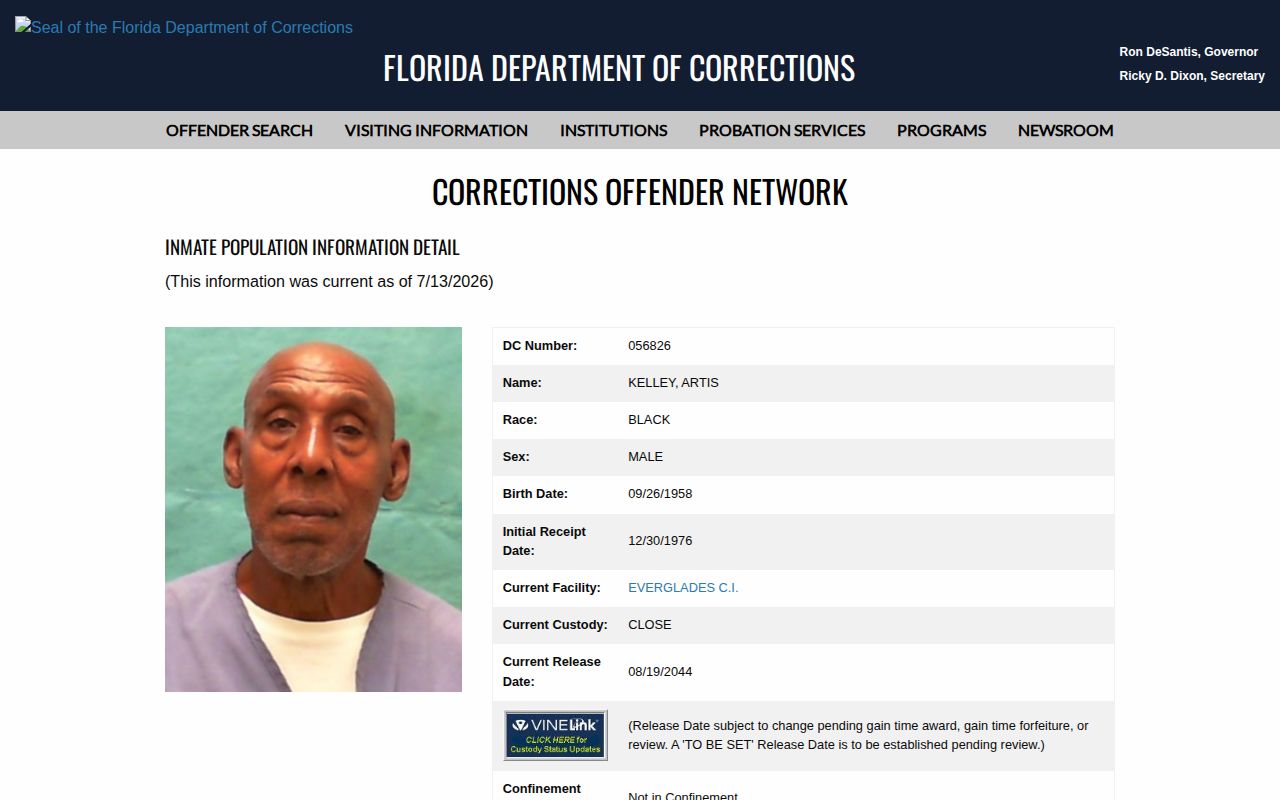
The value must be rechecked against the current result. A saved image or old date cannot account for later sentence or gain-time changes.
Note: FDC public information is not an instant county booking record and should be confirmed with the agency that controls the sentence.
Read Highlands FDC Date Fields
An FDC public result can display the name, DC number, photograph, aliases, physical description, current custody or supervision status, location, offense and sentence rows, release date, release type, and supervision history. The exact set depends on whether the result comes from the inmate population, released population, or community-supervision search. Older records may look different from current cases.
The dedicated release-information form accepts last name, first name, and a six-character DC number. Its name search works by prefix, can include aliases, and can limit results to records with photographs. A DC number is still the best key because it stays tied to the state record when names or spellings vary. FDC lists its Bureau of Admission and Release for questions about release dates, while certified or fuller material follows the Department’s public-records process.
For a completed state release, compare Release Date with Date Out-Custody in the incarceration history. Corresponding values strongly support that FDC prison custody ended. Then read Release Type and any community-supervision history. A person may be out of prison but still subject to parole, conditional release, probation, or another state term. Conversely, a new institution or “in transit” location shows continuing custody, not release.
A detainer entry deserves care. It may identify another authority’s interest and can include a cancellation date, but the public field alone may not establish what happened at the gate. Ask FDC or the receiving authority when one sentence ends but another hold may continue. Abbreviated offense text also does not replace the judgment. Use the Highlands Clerk docket or the court that imposed the sentence for the full legal record.
Highlands Pretrial Release Timing
A pretrial detainee generally has no sentence-based release date. Release may depend on bond, release on recognizance, a court order, dismissal, resolution of another charge, or satisfaction of a separate hold. A bond amount on the current HCSO roster does not establish that bond was posted. It also does not show when Booking completed the exit.
Use the Highlands Clerk court-records gateway to find the legal authority, then HCSO to verify the actual physical release. A court order can precede identity checks, paperwork, property return, and review of other holds. If another county, FDC, USMS, or ICE assumes custody, disappearance from the county roster reflects a transfer rather than freedom. That is why a precise date question begins with custody type instead of a broad name search.
After a county release is processed, HCSO Central Records holds the durable booking and release entry. Request the actual date and time, release type, authority, booking number, and receiving agency when that field is public. The Clerk explains why release was authorized; the jail record establishes when the person left that custody.
Florida Prison Gain-Time Rules
Florida Statutes section 944.275 governs FDC gain-time calculations. The process starts with the sentence structure and lawful jail credit. FDC then applies the gain-time law tied to the offense date, sentence type, and eligibility. Incentive gain-time may be awarded over time and may also be forfeited under the governing rules.
For covered offenses committed on or after October 1, 1995, gain-time cannot permit release before service of 85 percent of the imposed sentence. Court-awarded credit for time physically incarcerated counts toward that floor. The rule is not a shortcut for predicting a person’s date. Some offenses and sentence types have exclusions, historical rates differ, and a life sentence cannot be turned into a simple 85-percent date.
The statute calls the gain-time result tentative because awards and forfeitures remain part of the calculation. Maximum sentence expiration is a separate concept. Anyone reviewing an FDC date should keep the judgment, jail credit, consecutive or concurrent terms, and the current state record together.
The statutory source displays the governing text. The official tentative-release statute is shown below.
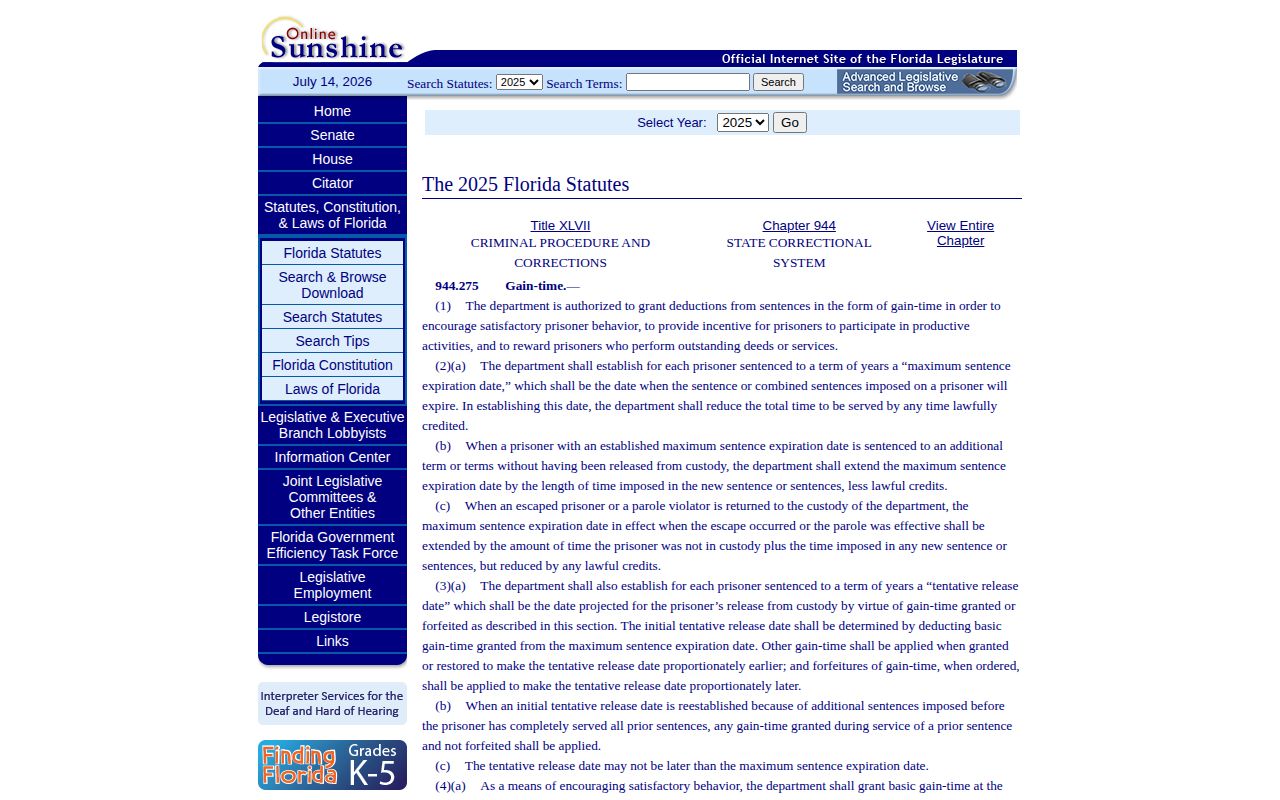
Its terms apply to FDC prison calculations. They should not be copied into a Highlands County jail sentence as if both systems used one formula.
Highlands County Sentence Tracking
The HCSO Operations Division states that its Classification unit tracks each inmate’s sentence length so the proper confinement period is served. The researched Sheriff pages do not publish a county good-time rate, a standard weekend advance, or a holiday-release formula. This negative finding matters. A generic online calculation cannot replace the sentencing order and HCSO’s individual computation.
Florida Statutes section 951.21 supplies a separate county good-conduct framework. Subject to county policy, it describes maximum commutation of up to five days per month in the first two years, ten days per month in years three and four, and fifteen days per month after that. It also allows a locally adopted meritorious allowance of up to five days per month and provides for forfeiture.
No current Highlands County adoption, discontinuance, or revision policy was located in the supplied research. The statutory maximums therefore cannot be inserted into a person’s date. Ask for the court order, jail-credit entry, and HCSO calculation. A sentenced person awaiting transport to FDC may also remain at the county jail while the state sentence record is being set up.
Highlands calculation rule: Use HCSO sentence tracking for a county term and FDC section 944.275 calculations for a state prison term.
Why Highlands Release Dates Change
A projected date can move in either direction. The cause may arise in the sentence, the credit calculation, institutional conduct, a separate case, or the authority expected to take custody next. Reading only the displayed date strips away the facts that control it.
| Factor | Possible effect | Record to verify |
|---|---|---|
| Gain-time award or forfeiture | Moves the FDC tentative date under governing law and rules | Current FDC calculation |
| Amended jail credit | Changes credit applied to the sentence | Court order and FDC or HCSO record |
| Concurrent or consecutive term | Changes how multiple sentences combine | Judgment and sentence rows |
| Vacated count or resentencing | Changes the lawful sentence basis | Later court order |
| Escape or parole-violation time | May add time excluded from the calculation | FDC and FCOR records |
| Detainer or other hold | May cause a custody handoff after one term ends | Custodian and receiving authority |
Parole deserves special care. Most modern Florida offenses are not parole eligible, and an FCOR interview or agenda entry is not a grant. Conditional release and other post-prison supervision can begin when incarceration ends. The Highlands County parole and probation record explains how to verify that separate status.
Note: The end of one sentence does not guarantee a community exit when another lawful hold or sentence remains.
Confirm Highlands Actual Release
A future date should be monitored, not treated as final. FDC’s dedicated release search is the right state channel for scheduled or completed FDC release information. For a county sentence, HCSO and the Highlands Clerk are the paired sources. If a date disappears, changes, or conflicts with another record, ask the agency for an official calculation or existing release record.
Florida Statewide VINE can provide a custody-change notice when the relevant agency and person are covered. The VINELink release check explains how to match one person and register for notice. An alert remains a notification layer. Confirm actual time and release type with HCSO for county custody or FDC for state prison custody.
Once release occurs, record the actual date, release type, facility, and identifying number. For an FDC result, compare Release Date with Date Out-Custody and read any supervision history. For HCSO, request the booking/release entry. That final step turns a changing estimate into a documented event.
When a county sentence is involved, a narrow request through HCSO Central Records can ask for the existing incarceration or booking/release entry, actual exit date and time, release authority, and any correction to the record. Include the booked name, approximate booking date, MNI or booking number, and case number when known. HCSO should be asked for the record it keeps, not for a new calculation written as an answer to a questionnaire.
For an FDC sentence, request the release-date calculation history or discharge information by DC number when the public screen does not resolve the issue. FDC and HCSO are separate custodians. The Sheriff cannot certify a state-prison discharge, while FDC ordinarily cannot certify the county jail’s physical exit time. The correct final source always follows the custody that actually ended.